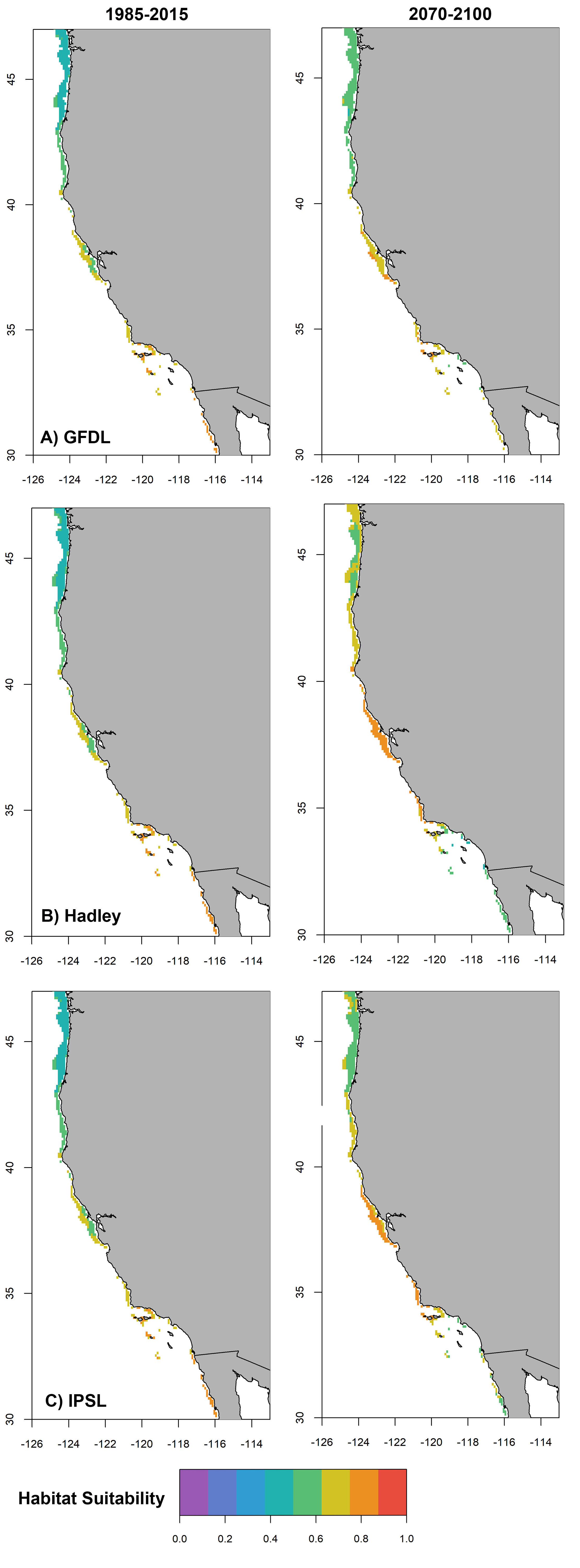
California Market Squid (Doryteuthis opalescens) is often ranked as the top fishery in the state for both pounds landed and ex-vessel value, but the short-lived species’ abundance and distribution is tightly tied to environmental conditions. To prepare for the impacts of climate change, we need to understand the vulnerability of both Market Squid and squid fishery participants to future conditions in the California Current System. I used a network analysis approach to examine how relationships among squid permitted vessels, squid buyers, and ports adapted to past climate perturbations (El Niño and La Niña years). I then used a dynamically downscaled climate model to project changes in Market Squid’s habitat suitability and center of gravity by the year 2100.
There was a sharp decline in total pounds landed at California ports during the 2015-2016 El Niño. indicating the the Market Squid fishery vulnerable to future warming. However, larger vessels with greater spatial mobility and buyers with receiving capacity and processing facilities in multiple locations may be more resilient to projected decreases in habitat suitability in Southern California and increases in habitat suitability in Northern California. The majority of relationships between vessels and buyers carried through multiple years, with only 32% of vessels selling to new buyers in different thermal conditions. This fidelity is likely adaptive, ensuring access to processing facilities and markets while allowing for flexibility when necessary.
Most squid fishery participants have long personal and family ties to the fishing community. Improving understanding of Market Squid fishery’s resilience and adaptability to changing conditions can inform management to support climate-ready fisheries.
 Ellen Willis-Norton